
Executive Summary
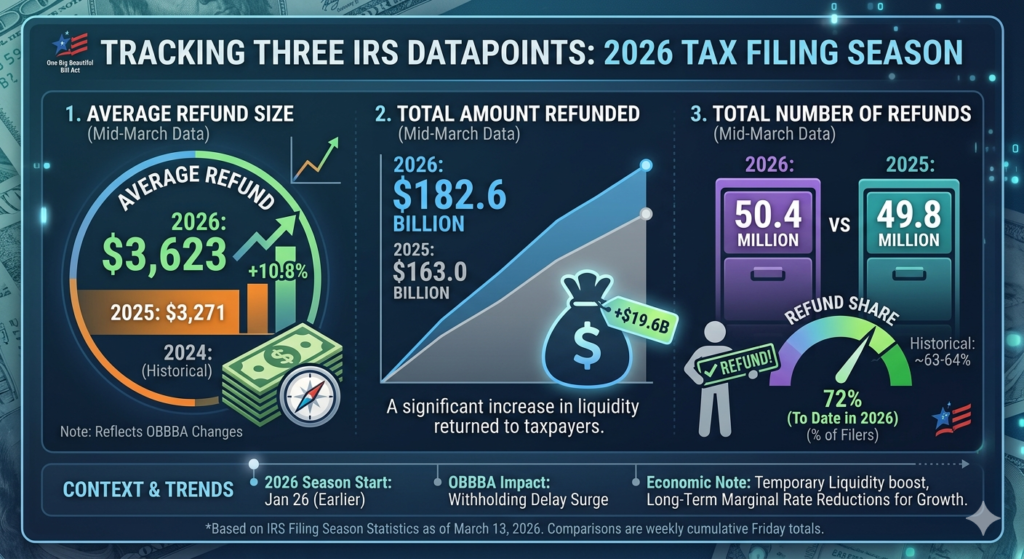
The 2026 tax filing season is projected to yield significantly higher average refunds compared to 2024 and 2025. This shift is primarily driven by the legislative changes introduced in the One Big Beautiful Bill Act (OBBBA). Current data as of the sixth week of reporting shows total refunds reaching $182.6 billion—a nearly $20 billion increase over the same period last year ($163 billion). Furthermore, the average refund has surged by 10.8%, currently standing at $3,623.
Introduction
The 2026 filing season marks the implementation of the OBBBA, which introduced several new deductions for tip income, overtime pay, auto loan interest, and senior citizens. The observed increase in refund sizes is largely attributed to the fact that 2025 tax cuts were not immediately integrated into IRS withholding tables, resulting in widespread over-withholding throughout the prior calendar year.
While these retroactive provisions are driving a temporary surge in refund liquidity, the long-term economic benefits of the OBBBA are expected to stem from permanent reductions in marginal tax rates, which provide sustained incentives for workforce participation and economic growth.
We are monitoring three specific IRS data points to evaluate the OBBBA’s impact on the filing landscape.
- Average Refund Size
As of March 13, 2026, the average tax refund was $3,623, representing a 10.8% increase over the $3,271 average recorded on March 14, 2025. Per statutory requirements, the IRS must delay the release of returns containing the Earned Income Tax Credit (EITC) and Additional Child Tax Credit (ACTC) until mid-February. Consequently, refund averages typically climb in late February before stabilizing.
- Aggregate Refund Volume
During the 2024 and 2025 filing years, the IRS issued approximately $329 billion in total refunds, with over two-thirds disbursed prior to April 15. In 2026, the IRS has already refunded $182.6 billion as of March 13, compared to $163 billion at the same point in 2025. While early-season totals can fluctuate as taxpayers await necessary documentation, the current trajectory shows a marked increase in capital being returned to the private sector.
- Total Number of Refunds Issued
Historical data shows a consistent refund rate among filers:
- 2024: 104 million refunds issued out of 163.5 million returns (64.1%).
- 2025: 103.8 million refunds issued out of 165.8 million returns (62.6%).
As of March 13, 2026, the IRS has processed 50.4 million refunds, up from 49.8 million in 2025. Notably, 72% of returns filed to date in 2026 have resulted in a refund, a significant uptick from previous years.