
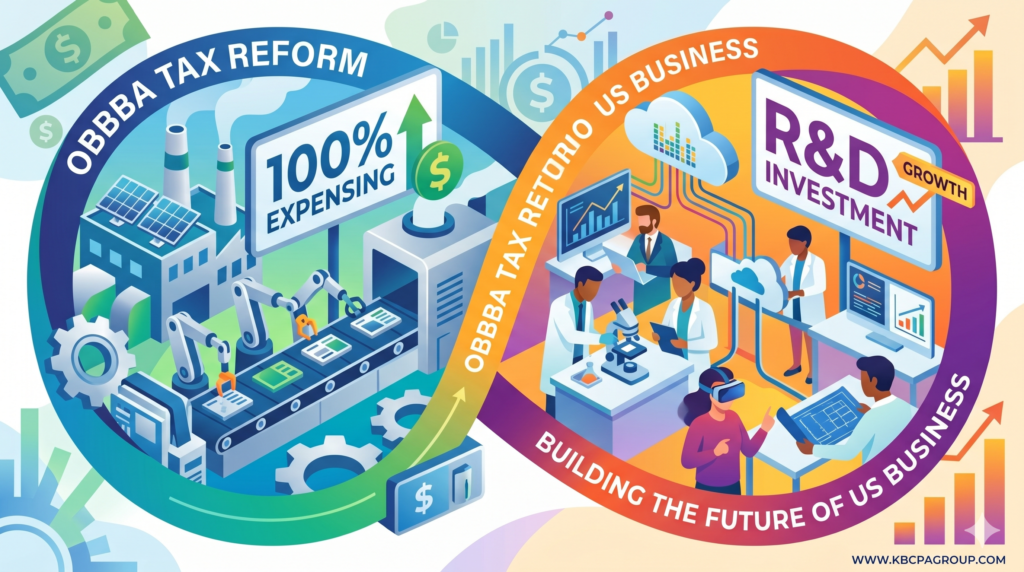
The One Big Beautiful Bill Act (OBBBA) marks a significant shift in U.S. tax policy by prioritizing “expensing” a method that allows businesses to deduct the full cost of investments immediately rather than stretching those deductions over decades.
While the OBBBA has already fueled growth, its current limitations suggest that more comprehensive reform could unlock even greater economic potential.
The Power of Immediate Expensing
In tax terms, expensing is far superior to depreciation. When a business must depreciate an asset over several years, inflation and the “time value of money” erode the value of their tax write-off.
Example: A $1,000 equipment investment depreciated over six years (at 3% inflation) actually loses 18% of its real value. For a corporation, this effectively raises the cost of that investment by 3.8%.
By allowing companies to write off the full amount in Year 1, the tax code removes this “investment penalty,” encouraging businesses to expand, modernize, and hire.
Major Changes Under the OBBBA
The OBBBA solidified several temporary measures from previous tax acts and introduced new incentives focused on domestic production.
Key Provision Breakdown
| Provision | Affected Assets | Major OBBBA Change |
| Section 179 | Equipment, HVAC, Furniture | Increased deduction limit to $2.5M; phaseout starts at $4M. |
| Bonus Depreciation | Machinery, Software, Film/TV | Made the 100% deduction permanent (starting Jan 2025). |
| Section 174 (R&D) | Domestic Research & Software | Reverses previous requirements; allows full immediate expensing for domestic R&D. |
| Section 168(n) | Manufacturing Structures | Temporary expensing for new factories built between 2025 and 2029. |
Economic Impact and Evidence
The data suggests that when it is cheaper to invest, companies do it more often. Research indicates that expensing, specifically bonus depreciation directly correlates with increased capital investment and higher employment rates. It has proven particularly beneficial for small to mid-sized firms and has shown positive employment effects for diverse workforces.
The Numbers at a Glance
According to the Tax Foundation and CBO models, the OBBBA’s expensing provisions are expected to have the following long-run impacts:
- GDP Growth: Projected +0.7% increase in long-run GDP.
- Cost: Estimated $703 billion in conventional revenue loss over 10 years.
- R&D Boost: Reversing R&D amortization is expected to recover billions in lost innovation investment.
The “Unfinished Business”: Structures
While the OBBBA is a “pro-growth” win, a massive hurdle remains: Buildings. Most residential structures are still depreciated over 27.5 years, and nonresidential buildings over 39 years. This long timeline acts as a heavy tax on construction.
- The Potential: Expanding full expensing to all structures could boost long-term GDP by an additional 1.3%.
- The Housing Angle: Applying these rules to residential buildings could result in the construction of 2.33 million new homes over the long run.
Final Takeaway
The OBBBA has set a permanent foundation for US investment by fixing the treatment of equipment and R&D. However, the temporary nature of manufacturing incentives and the exclusion of general structures mean the “Big Beautiful Bill” is just the first chapter in a larger growth story.