
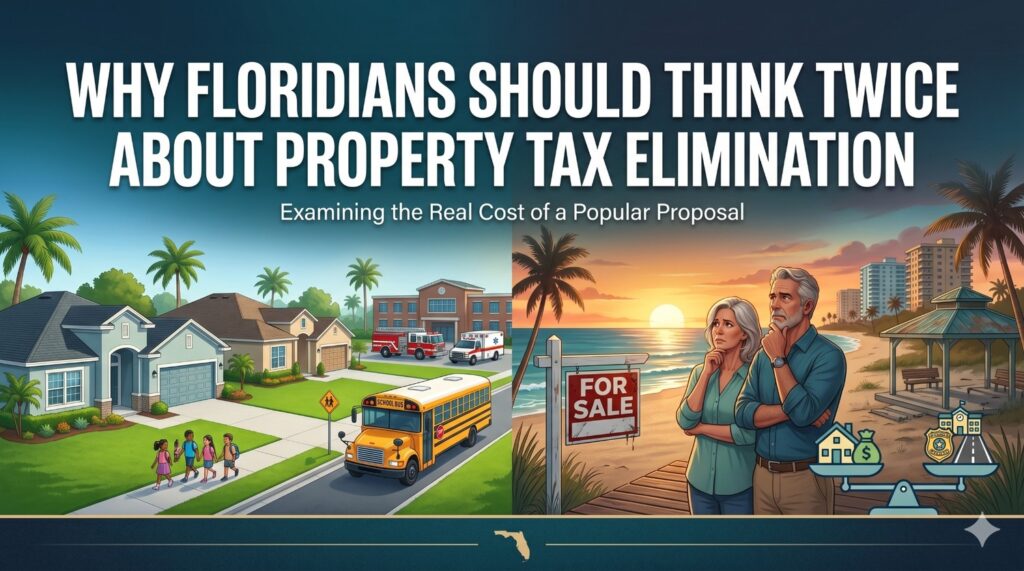
Few issues unite homeowners quite like a shared disdain for rising property taxes. It is no surprise, then, that proposals to eliminate or sharply reduce these taxes in Florida have gained significant momentum.
This November, Florida voters will decide on a constitutional amendment proposal titled “Save our Homes from Excessive Property Taxes” (HJR 1). The amendment aims to drastically increase homestead exemptions and establish a path toward exempting the remaining value of primary residences from taxation. It requires a 60% voter approval to pass.
While a massive tax cut sounds incredibly appealing on the surface, the broader economic realities suggest that this move could severely damage the state’s infrastructure, public services, and overall economic stability.
The Scale of the Tax Cut
There is no denying that Florida’s property tax burden has grown rapidly. Since 2019, state property tax collections have surged by 47.5%—jumping from $39.7 billion to an estimated $59.2 billion in 2025. Meanwhile, the state’s population grew by just 8.9%.
However, slicing this revenue creates a massive financial void. Legislative fiscal analysis estimates that the proposed amendment would reduce local government revenues by:
- $4.6 billion in the first year.
- $8.4 billion in the second year.
Currently, there is no viable plan to replace this missing funding.
Why Property Taxes Matter: The Benefit Principle
While property taxes are unpopular with the public, economists view them as a highly efficient way to fund a society. In Florida, property taxes make up 74% of all local tax revenue.
They operate on the benefit principle: the taxes you pay closely align with the tangible benefits you receive. Your annual property tax bill directly funds:
- Reliable local infrastructure and roads
- Public schools
- Emergency medical services, fire departments, and police
If property taxes are eliminated for primary homeowners, the cost of maintaining these essential services does not disappear. Instead, the financial burden shifts to a much smaller group of taxpayers, or the services themselves face severe budget cuts.
The Hidden Costs: What Replaces the Revenue?
To cover an $8.4 billion shortfall, the state would likely have to rely on a steep increase in sales tax. According to research from the Tax Foundation, completely eliminating property taxes in Florida would require an average state sales tax rate of 15.34%.
Even though HJR 1 only seeks a partial elimination, a substantial sales tax hike would still be required to keep local governments afloat. This presents two major problems:
- Border-Shopping and Tax Avoidance
A high sales tax makes local businesses uncompetitive. For example, residents in Northern Florida could easily drive across the state line to shop in Alabama or Georgia, where average combined sales tax rates sit at 9.46% and 7.49%, respectively. While you cannot move a house to avoid property taxes, you can cross state lines to buy goods, stripping Florida of expected sales tax revenue.
- Loss of Local Control
Shifting funding from local property taxes to state-controlled sales tax revenue adds administrative complexity. More importantly, it strips local communities of the power to make independent financial decisions regarding their own schools, parks, and emergency services.
Conclusion: A Threat to Quality of Life
Florida currently enjoys a highly competitive tax structure that successfully attracts new residents, families, and businesses. Drastically altering this ecosystem with an unstable revenue model risks making the state’s tax code unpredictable and distortionary.
Everyone wants to pay less in taxes. However, trades-offs are inevitable. Before casting a ballot this November, Sunshine State voters must look past the immediate appeal of a lower tax bill and carefully consider the long-term impact on their communities, public safety, and daily quality of life.